

Understanding the Reality of Returning to Work
Returning to work after maternity leave is one of the most significant transitions a working mother will face. Yet many organizations and managers still operate under the outdated assumption that mothers should simply pick up exactly where they left off — same pace, same output, same availability. The reality, however, is far more complex. Your body has changed, your priorities have shifted, and your responsibilities at home have fundamentally transformed. Acknowledging this truth is the first step toward a successful transition.
Recent research from HR leaders and talent acquisition professionals reveals that the traditional “day-one performance test” approach to maternity leave returns is not only unrealistic but actively harmful. Instead, forward-thinking organizations are embracing a 30-day ramp-back mindset that prioritizes sustainable reentry over immediate productivity. This approach recognizes that returning to work isn’t about catching up on everything — it’s about getting grounded again in a new reality.
The transition back to work doesn’t have to be overwhelming. With intentional planning and clear boundaries, you can create a sustainable return that protects both your career and your well-being. This is where the 30-day ramp-back strategy comes in.
What Is the 30-Day Ramp-Back Strategy?
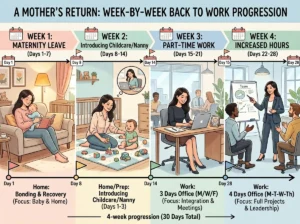
The 30-day ramp-back strategy is a structured approach to returning from maternity leave that spreads your reentry across a full month rather than attempting to regain full productivity on day one. Think of it as a gradual climb back to your previous capacity, rather than a sudden jump. During these 30 days, you focus on three core objectives: reconnecting with your role, rebuilding your systems and routines, and establishing sustainable boundaries that will protect your long-term success.
This strategy is grounded in the understanding that your brain needs time to adjust. You’ve been operating under a completely different set of demands for months. Your calendar has been structured around feeding schedules, pediatrician appointments, and sleep cycles. Your mental load has been consumed by parenting decisions. Asking yourself to instantly return to pre-baby productivity levels is not only unrealistic — it’s a recipe for burnout.
The 30-day ramp-back strategy permits you to be intentional about your return. It acknowledges that things have changed, and that’s not a weakness — it’s simply reality. By working with this reality rather than against it, you can build a career comeback that is both sustainable and successful.
The Three Pillars of the 30-Day Ramp-Back
The 30-day ramp-back strategy rests on three essential pillars that work together to support your transition. Understanding each pillar will help you implement the strategy effectively in your own situation.
Pillar 1: Reconnection and Context
Your first priority during the ramp-back period is to understand what has changed during your absence. Rather than trying to piece together everything on your own, ask for a simple download of key changes. This might include new team members, shifted priorities, completed projects, or organizational changes. By gathering this context intentionally, you can focus your energy on what truly matters now rather than wasting time on outdated information.
Pillar 2: Calendar and Time Management
Your calendar is likely to fill up quickly as colleagues and managers want to reconnect with you. During the ramp-back period, you need to actively manage this. Add buffer time between meetings — even 10 minutes makes a significant difference. Block dedicated thinking time and actually protect it. Consider pausing or shortening standing meetings for the first few weeks. Time management during this period isn’t about squeezing more in; it’s about giving yourself room to breathe.
Pillar 3: Boundary Setting and Communication
Clear boundaries are not optional during your ramp-back period — they’re essential. Be explicit about your start and end times. Reset expectations around response speed. Communicate your childcare transitions proactively. These boundaries aren’t a lack of commitment; they’re how you stay in your career for the long haul. When you model strong boundaries, you also give permission to other working parents on your team to do the same.
Week-by-Week Ramp-Back Timeline
Breaking down your 30-day ramp-back into weekly phases helps make the transition more manageable. Each week has a specific focus that builds on the previous week.
Week 1: Reconnection and Grounding
Your first week back should be about reconnection, not productivity. Schedule one-on-one meetings with key colleagues and your manager. Ask them what’s changed, what’s stayed the same, and what they need from you now. Listen more than you talk. Spend time reviewing emails and documents, but don’t feel pressured to respond to everything immediately. Your goal this week is to feel grounded in your role again, not to solve every problem that emerged during your absence.
During week one, also establish your new daily rhythms. Figure out your realistic start time given your childcare situation. Identify your peak productivity hours and protect them fiercely. If you’re nursing or pumping, schedule this time explicitly on your calendar and communicate it to your team. This isn’t something to hide or apologize for — it’s simply part of your reality now.
Week 2: Strategic Prioritization

In week two, you’re ready to start engaging more actively with your work. However, resist the urge to tackle everything at once. Instead, practice ruthless prioritization. Each day, identify three priorities that genuinely move your work forward. Everything else is secondary or can wait. This shift from volume to impact will reduce your mental load significantly and help you feel more in control of your workload.
This is also the week to reset your calendar if needed. If you’ve accepted too many meetings, it’s okay to decline some or reschedule them. Your calendar should reflect your actual capacity, not an imaginary version of yourself without childcare responsibilities.
Week 3: Building Momentum
By week three, you’re finding your rhythm. You understand what’s changed, you’ve reconnected with your team, and you’ve established your boundaries. Now you can start building momentum. Take on slightly more responsibility, but continue to monitor your energy levels. This is not the time to volunteer for extra projects or commit to new initiatives. Focus on doing your core work well and sustainably.
Week three is also a good time to check in with yourself emotionally. How are you feeling? Are your boundaries holding? Do you need to adjust anything? This reflection is crucial for long-term success.
Week 4: Integration and Sustainability
By week four, you’re approaching your normal capacity, but you’re doing it in a way that’s sustainable. You’ve established routines that work for your new reality. You understand your boundaries and you’re protecting them. You’ve built relationships with your colleagues and communicated your needs clearly. At the end of week four, you should feel like you’ve successfully reintegrated into your role — not because you’re working at your pre-baby pace, but because you’ve built a sustainable rhythm that works for your current life.
Practical Tools for Your Ramp-Back Success
Having the right tools and resources can make your ramp-back significantly easier. Consider implementing these practical strategies.
The 30-Day Ramp-Back Checklist
Create a simple checklist that guides you through each week. Include items like “Schedule reconnection meetings,” “Reset calendar,” “Identify three daily priorities,” and “Check in on boundaries.” Having a checklist gives you a sense of progress and helps you stay focused on what matters most during this transition period.
The Impact-Over-Volume Framework
Rather than measuring success by how busy you feel, measure it by impact. Ask yourself: “What actually matters today?” and “What will move the needle on my most important work?” This framework helps you stay focused on quality over quantity, which is especially important when your energy and time are limited.
The Boundary Communication Template
Create a simple email or message template that communicates your boundaries clearly. For example: “I’m ramping back in over the next month. I’m available from 9 a.m. to 4 p.m. on weekdays, with a break for childcare pickup at 4 p.m. I’ll respond to emails within 24 hours. For urgent matters, please reach out directly.” This clear communication prevents misunderstandings and sets expectations from the start.
Managing the Mental and Emotional Transition

The ramp-back period isn’t just about logistics and productivity — it’s also about managing the emotional complexity of this transition. Many mothers experience guilt, anxiety, or a sense of identity confusion when returning to work. These feelings are completely normal and valid.
One powerful strategy is to reframe your return as not about becoming who you were before, but about building a new version of yourself. You’re not the same professional you were before maternity leave — and that’s actually a strength. You’ve gained new perspectives, new priorities, and new resilience. Your role now is to integrate these changes into your professional identity, not to erase them.
Additionally, consider finding or creating a community of other mothers navigating similar transitions. Whether it’s a formal support group or an informal chat with colleagues who’ve been through this, having people who understand what you’re experiencing makes a tremendous difference. You might also consider rediscovering your professional identity as part of your ramp-back process.
What to Do If Your Organization Doesn’t Support a Ramp-Back
Ideally, your organization will actively support your ramp-back by offering flexible schedules, phased returns, or other accommodations. However, not all organizations are there yet. If you’re in a situation where your employer isn’t formally supporting a ramp-back, you can still implement many of these strategies independently.
Start by having a conversation with your manager about your needs. Frame it around what will help you be most effective in your role. Explain that a sustainable return benefits both you and the organization. If your manager is resistant, consider whether there are informal ways to implement the strategy — perhaps by being more intentional about your calendar management or by seeking support from colleagues.
If your current organization truly isn’t supportive of working mothers, it may be worth considering whether this is the right environment for you long-term. Many companies are recognizing that supporting parents’ transitions is not just the right thing to do — it’s also good business. Your talent and experience have value, and you deserve an organization that recognizes that.
Your 30-Day Ramp-Back Starts Now
Returning to work after maternity leave is a significant life transition, but it doesn’t have to be overwhelming. By implementing the 30-day ramp-back strategy, you’re permitting yourself to transition thoughtfully and sustainably. You’re acknowledging that things have changed and building your career comeback around your current reality, not an imaginary pre-baby version of yourself.
Remember: your ramp-back isn’t about proving yourself or catching up on lost time. It’s about building a sustainable career that works alongside your role as a mother. With clear boundaries, intentional prioritization, and support from your team, you can make this transition successfully. You’ve got this — and you don’t have to do it alone.
For additional support during this transition, explore our resources on balancing career ambitions with family life and managing the mental load of working motherhood.